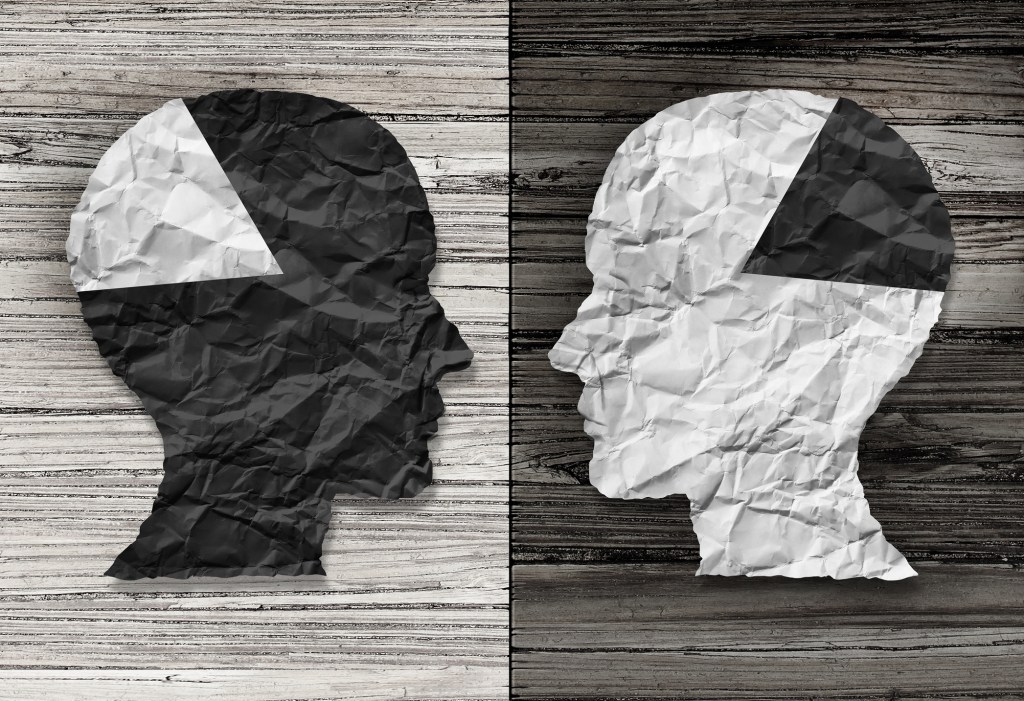
There is a fundamental dispute being played out in the western world daily. This dispute will ultimately lead to senseless violence unless we as “western society” work with patience and understanding to bridge the communication gap. I by no means have the answers, but I have noticed a few salient points through saturnalias with like-minded people and solitary deep reflections.
As a society and a civilization, we have decided that categorizing entire social groups as having certain fixed traits is largely bad, thereby creating an implicit agreement that such labeling is “racist”. Arbitrarily placing every member of a demographic group into a single, non-distinct group by virtue of certain shared characteristics reminds us of the many unmerited and dehumanizing policies previously justified in the name of race. The modern difficulty has sprung from two differing views on what racism consists of, separating proponents into two diametrically opposed factions. Moreover, the term “racist” is now often used to shut down conversations rather than leading to meaningful dialogue.
The factions arose as a result of competing interpersonal societal dynamics designated as ‘truths’ by each faction. The First Group’s truth: is the idea that each individual should be treated as an individual no matter the group to which they belong. The Second Group’s truth: is that the first truth can be absurd at a practical level, especially when an individual person displays several stereotypical characteristics or behaviors that are typically reflective of the larger social group to which the observed individual belongs. The latter part of this second truth became problematic since by indicating or referring to the second truth in the ‘incorrect’ manner, a member of the second group could be labeled a racist by the First Group for daring to notice that individuals in social groups tend to have certain shared behaviors or characteristics.
The conflict then arises when individuals in First Group categorically refuse to acknowledge that social groups tend to follow certain trends or have predominant characteristics. However, the First Group contradicts itself with the view that accepting certain behaviors and general characteristics can or should be expressed, via “most [insert noun] are [Insert adjective]” with respect to certain (majority) groups (of power). Thus, making a blanket statement about one social group may raise no reaction, while making the same statement about a different social group makes the statement racist.
For example, in both news, media and in the academic world if someone says “most White people are bad,” very few people will make an issue out of it. However, if one inserts a minority group’s race instead of the term White, then the speaker is declared a bigot or racist if he does not couch the statement within approved, yet undefined parameters.
The justifications are arbitrary by logical standards. According to the new age (modern) definition of racism, only white people can be racist because of historical injustices and power dynamics perpetrated by whites against other races. So, “most white people are bad” is considered a mere historical fact, with evidence required to substantiate the Ad Hominem asserted. The justification rests solely on the elementary proposition that “power” is the source of one’s ability to be harmfully discriminatory, but this proposition is a based Appeal to Motions and is based on a feeling, not based on the rationality of fairness between two individuals(or groups).
The position that harmful discrimination should be condemned is not a position that is solely dependent on the race of the utterer/committer, or the race of the object of said discrimination. Otherwise discrimination is riding a seesaw of power dynamics in a racial struggle dependent on the group one belongs to, which then taken to its logical conclusion turns into an eye for an eye: we discriminate against you because you (usually the subjects perception of the objects ancestral lineage) discriminated against me and my ancestry. Which means in the future, the group who is being currently “properly discriminated against” will have grounds for redefining what constitutes “improper discrimination” when the social dynamics favor their version of logical fallacies.
As an example of the most immediate resulting flipping of improper to proper discrimination, South Africa, provides the extreme case with its Post Apartheid policies. When looking at South African racial politics post-Apartheid and the state of the country today. It is easy to admit that Apartheid used an anachronistic system of governance that treated all native black South Africans as second class citizens merely based on their skin color and heritage. However, the current treatment of the white South Africans does not look much different than how the native South Africans were treated. While understandable, as the injustice of Apartheid is still fresh in the country’s eyes. It is a perfect example of how power based on the personal position [one’s race] corrupts more than any other characteristic that is given power.
Is this ideology any better than the racial discrimination the term “racist”, or the ending of Apartheid was originally seeking to address? No, it is using the opposite end of the same extreme, and not realizing that they are all part of the same horseshoe.

Now let’s compare the modern view of a racist to the classical view. The Classical view asserts that no matter which noun is inserted in the statement, if it is “racist” against one social group then it is racist against any social group. This has been the predominant definition of racism since the beginning of its coining. Furthermore, the term “racist” has been weaponized against individuals and groups to advance certain political or ideological agendas. It has been used to silence dissenting opinions, discredit opponents, and stifle free speech without logical justification.
For better or worse, everyone is placed as a member of one of these factions, First Group, or Second Group, when the term racist is used. If it ended there, things might be easier to parse, even though most of the time neither side can articulate their position to the satisfaction of the other. However, the divide between these groups is exacerbated by their inability to explain in concrete terms when grouping people together constitutes racism and when it does not.
This further breakdown in the conversation is caused by the inability to explain the reason First Group finds a particular statement racist. Implicit in the term “racist” is the idea that what is being stated is false, bad, missing information, and/or uncomfortable. However, without further explanation as to why one interprets the particular statement as racist, it is unclear why the particular statement or action is being condemned. By using such a strong word without clearly explaining why a particular behavior or statement is harmful, the arbiter treats the person’s statements or behaviors as purely imaginary (as in a manner of coping that is not based in reality). Telling someone, “oh, that is racist” or “you are racist” signals to the speaker that they need to stop what they are saying because they are out of touch with a moral and just reality. Furthermore, the epithet “racist” signals that the conversation is corrupt, immoral, and the “racist” needs to change their behavior and their belief or be cast out from this particular social environment. Alternatively, the person labeled “racist” must remove themselves from this environment if they do not quickly correct what they are communicating. Yet, what truly divides people is when the conversation devolves into a fight over whether a statement is racist or not and the fundamental definition of racism (Modern vs Classical) instead of trying to understand each person’s underlying worldview and value system and accepting those differences.
Thus, society is asking busy people with diverse and complex lives to navigate these attacks and conflicting approaches instantaneously while fitting into modern society, social circles, and global life as many social interactions are being replaced by artificial social media exchanges. To add to the difficulty, most people are used to using heuristics—mental short-cuts–in their social interactions. Navigating the “racist” debate requires careful planning to say the proper thing in the clearest way possible given the particular situation; however, most of these conversations are generally unplanned. It is delusional to believe that this is practical since it takes way too long to think outside of one’s beliefs; especially when one is in a battle for one’s near and dear beliefs. Managing the conversation requires a decision tree, which is only helpful when one has time to analyze probabilities and various outcomes that lead to other probabilities, etc. But for everyday interactions, having an overly complex mental schema like the above is reserved for those with highly powered brain function and people with severe anxiety disorders, a very small percentage of the population. Therefore, most people are forced to choose sides in this convoluted space.
When the world we live in makes people choose a side, and then makes people feel evil for the side that they choose, everyone loses. I have been in conversations where I break all of this down, just for someone to start screaming at me that I am justifying violence or using a complicated way of justifying racism. This reaction is the crux of what I hope people realize: that we have corrupted the very building blocks of conversing about race to the point that when people disagree on this topic, they do not articulate themselves in a constructive manner. Rather, they get angry and talk past each other. Navigating the complex ways people view racism should lead to a form of ego death and a realization of “fuck, this shit is complicated.” The conversation should entail trying to understand someone’s personal motivations, not boxing them in with a label that only one’s own “group” understands. Still, it’s a lot easier to fall back on one’s beliefs and treat the other side as a threat, which is a primal reaction – especially if what one believes (one’s identity) is being attacked constantly and one is being called evil or being accused of bad intentions. At a certain point, people on both sides will realize (at least at a subconscious level) that conversations are not going to change and violence is the purest form of communication when words no longer lead to effective dialogue.
I pray to be wrong, and I chose the challenge of writing this in the hope of making a difference. So, all I ask is that the next time you use the word “Racist” or a similar term, please realize that most of what you are achieving is counterproductive and that its utterance only signals which side of the debate you are on. You are tricking yourself into believing that you are articulating something of substance to the other side. Instead, you are contributing to the violence that is an inevitable result of the modern decay of venting that we like to call communication. But ultimately, I might be the one tricking myself into thinking I have articulated something of substance.
I also pray for understanding. However, I do not pray for peace, since peace without understanding is just the illusion of a ceasefire when a shortage of ammunition is really the cause of the calm.
Please subscribe if you liked this
Make a one-time donation https://buy.stripe.com/14k4hledff901Rm9AA
Make a monthly donation
Make a yearly donation
Choose an amount
Or enter a custom amount
Your contribution is appreciated.
Your contribution is appreciated.
Your contribution is appreciated.
DonateDonate monthlyDonate yearly The Wall