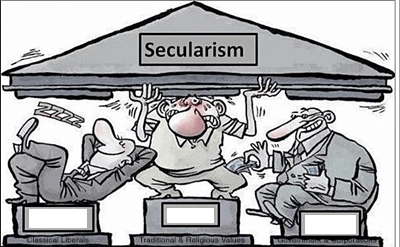
The following is an exploration of the meaning of the term Secular. As with many conceptual terms in modern vernacular, the term once meant one thing then shifted towards another use, then another use, and then there the modern application appeared. All of these meaning and uses of the term Secular are often blended together and used in a situation by which an explanation of a some other idea can be interpreted situationally but the ambiguity is the danger inherent in its usage. As the term secular is assumed to mean a certain set of confines but their is immediately surrounding verbs, adjectives and the context of conversation that will encroach and approach the nucleus of absurdity. As no reason can be had when a common definition of words is not agreed upon or explicitly evident by parties within the usage of the conceptual terms usage. Thereby, a historical as well as etymological analysis of how the word SECULAR was used and then became administered is necessary prior to explaining how Secularism was able to subvert tradition and become the worlds most dominant religion.
AFTER THIS
… IS THE OLD PIECE WHICH IS STILL UNDER major REVISION AS TO EXPLAIN MORE RECENT INSITES THAT HAVE BEEN THE DECENDANTS OF EXPRESSIONS ARTICULATED, DEBATED AND FAUGHT OVER IN SEVERAL MEDIUMS SINCE BEING ORGINALLY EXPRESSED. IF THERE IS A DESIRE TO SEE THE ORGINAL VERSION CHECK THE INTERNET ARCHIVE or not.
The prefix to to this is that I am not going to cited every influence. If it is true than citation is a mere formality, by which plagiarism is only a true mark when there is no creativity to the end conclusion of the various truths asserted.
We can first look at the etymology and then we can look at several of the ways in which it was used. But then we well review the Secularist Manifesto.
words is used quite often but it is used without explaining its origin.
There appears to be To me, there is a distinction between a completely religion-free civil society (its modern definition) and a civil society that is influenced by religion, without specific reference to religious doctrines (its classical definition).
In the past century and a half, there has been a tendency to conflate these two ideas. Perhaps it was initially an innocent mistake, as people became absorbed in technological advancements and traditional beliefs lost their hold in the face of easily accessible information and an array of other distractions. However, failing to differentiate between these concepts does a disservice to our understanding of where key civil rights get their gravitas from and how moral practices are shaped by our definitions, habits, practices, and religious frameworks.
When I refer to religious frameworks, I simply mean that, at its core, religion provides a means to explain the unexplainable or underexamined and to categorize phenomena in order to demystify that which is perplexing and may take longer than reasonable to understand. Over time, successful religious models have elaborated on these explanations and attributed them to a higher power that sets things in motion, while other models may simply provide emotionally comforting responses and reassurances about one’s powerlessness or ability to exert their agency. The specifics of which religious models fall into which category are not necessary to explore for the purpose of this essay.
The first part of this piece explains the fear that bore the term of secularism. The second part explains the effect of modern secularism
ON SECULARISM
Secularism is a word that has undergone significant changes throughout its history, making it both a brave and subversive concept. The meaning of the word has evolved so much that if one were to have a conversation with someone from before World War I about what secularism means, it would be like speaking in sign language to a person with no hands. To fully understand the breadth of the history of this term, it is necessary to explore the origins of the separation of state and direct religious influence in this country, otherwise known as the church. (further examined in my previous essay in the History-of-Freedom-of-Conscience section).
The First Amendment of the Bill of Rights states, “Congress shall make no law respecting an establishment of religion.” This simple statement at the time contrasted with the situation in many European countries and other continents where religion served as the direct source of morality, rules and order. In the Colonies, however, this was not to be the case. A certain religion or denomination was not to dictate morality.
James Madison, one of the key figures in garnering support from various provinces and colonies for the ratification of the Constitution and Bill of Rights, is known for his advocacy of civil rights and religious freedom. He famously declared, “The civil rights of none shall be abridged on account of religious belief or worship, nor shall any national religion be established, nor shall the full and equal rights of conscience be in any manner, or on any pretext infringed.” As I discussed in my previous paper, the term “conscience” holds significant meaning in the context of religious freedom, secularism and free will.
To digress into interpreting the intention behind the First Amendment is not my aim. Such an argument would be similar to those as originalism, textualism, and structural interpretation, which are questions of legal philosophy influenced by one’s moral imperative and worldview. This argument can be quite pedantic and focused on the literal meaning of words. Instead, this paper will focus on explaining the historical usage of the term secular(ism) and how its meaning has evolved over time which has affected how value systems are passed down.
Returning to Madison, he asked a crucial question in Article Three of the Memorial, “Who does not see that the same authority which can establish Christianity, in exclusion of all other religions, may establish with the same ease any particular sect of Christians, in exclusion of all other sects?” This quote highlights the fear that many of the founding fathers had. Most of them were from persecuted Christian groups and left Europe to be protected in a place where they could practice their beliefs without the church’s influence affecting their rights. It is important to understand this historical context to appreciate the significance and motivation of the separation of church and state in the US Constitution.
The drafting of the First Amendment was driven by fear, but it resulted in one of the most powerful legal proclamations of a right. However, the founders made the assumption, to a fault, that religion would always be a clear factor in politics, so they intended for religion to be an influencer but not for it to be codified.
James Madison addressed this concern in his writings, specifically referencing the situation in Virginia during 1784 to 1786. During this time, the “general assessment bill” was proposed in Virginia, which would have allowed the state to provide financial support to Christian religious denominations in an impartial manner. However, this bill was ultimately defeated, putting an end to the decade-long battle over the issue. The fear was that providing state support to one denomination it could lead to that denomination gaining too much control, similar to what had happened in several times Europe.
In his response to the “general assessment bill,” James Madison stated, “The sincere friends of liberty…who give themselves up to the extravagancies of this passion are not aware of the injury they do to their own cause.” However, when it came to government support of religion, Madison believed that religion was a unique situation where excessive caution was warranted, as it had the potential to become an overbearing force with harmful consequences.
This fear of religious domination in government drove the founding fathers to believe in a separation of church and state, which was not directly articulated but was conveyed through the First Amendment and many of their writings. Originally, the Constitution had a clause that required a religious test. However, Article VI, Clause 3 explicitly prohibits religious tests as a qualification for holding federal office, stating “but no religious Test shall ever be required as a Qualification to any Office or public Trust under the United States.” While the founding fathers were driven by a fear of other sects of Christianity taking control over the government, they ultimately enshrined the separation of church and state in the Constitution. The Constitution itself is generally silent on matters of faith, with the First Amendment extending a right to the free exercise of religion, but intentionally not endorsing any particular religion or set of religious beliefs.
The First Amendment is a clear signal that the government should remain neutral on matters of faith and allow individuals to practice their religion freely without interference from the state. However, while early American leaders recognized the positive role that religion could play in society, they were also cautious about the potential for religion to become a tool of political power and control. Despite this neutrality, however, the United States government has historically acknowledged the role of religion in promoting civic virtue and morality, as evidenced by the use of religious texts and references in political speeches, and documents.
In his Detached Memoranda, James Madison expressed his fears about the potential for religion to become intertwined with the government. He acknowledged that the Constitution of the United States strongly guards the separation between religion and government, but he also recognized the danger of encroachment by ecclesiastical bodies. Madison was impressed by the idea of a union of all citizens to form one nation under one government in acts of devotion to the God of all, but he also warned against the dangers of a direct mixture of religion and civil government. He believed that this could lead to a situation where individuals use their religion as a means of abridging the natural and equal rights of all men, in defiance of their own declarations that their kingdom was not of this world. Despite these concerns, some continue to deny the potential dangers of mixing religion and government.
As time went on, in an effort to prevent the government from becoming religiously corrupt, the concept of secularism emerged. Politicians and leaders appealed to the masses using religious beliefs without expressly relating them to scripture, leading to the development of secularism. This is why the religion and denomination of each president is a matter of common knowledge, and why it was a big deal when the first Baptist president, Warren G. Harding, was elected.
If the concept of secularism meant that religion and state should remain completely separate, then why would the denomination of a president ever matter? In a truly secular society (under the modern definition), it would be reasonable to not care about the president’s faith, and it would be of no consequence. However, in reality, the religion and denomination of each president is a matter of common knowledge, and has always been a big deal. For instance, when JFK became the first Catholic president. In the past, the personal affairs of politicians were seen as inconsequential and not newsworthy to journalists. However, in the tradition of secularism set by the founding fathers, no denomination could be established as supreme in the eyes of the government. Unfortunately, with practices such as Jim Crow and segregation, certain Christian denominations held higher status at the state and local levels, while others, such as Catholics, were considered of lower status.
The irony lies in the fact that in Madison’s Detached Memoranda, he expressed his concern about chaplains being paid by the government and how it could lead to corruption, as he expressed in Latin, “maculis quas aut incuria fudit, aut humana parum cavit natura,” which means faults originating from carelessness, or of which human nature was not sufficiently aware (Horace). Madison’s carelessness in discussing religious ethos, which he assumed would always be separate from the government, which has led to the modern conception of secularism that has assisted in the deviation from this ideal.
The question that crawls out from the page is “WHY IS THIS A PROBLEM?”
Despite the absence of a canonical definition, classical secularism was upheld by communities that had their own religious and faith-based canons that dictated their ethos. However, as these communities began to dissolve, the practices that were specific to secularism deteriorated. The implicit expression and social contract of rights derived from a faith-based ontology weakened as people in the 1960s and 1970s were distracted by new lifestyles, ideas, and material possessions that were no longer solely dependent on the systems in which they were raised.
As society “progressed”, people began to create new lifestyles that were no longer related or tied into the culture they were raised in. While many still held onto the traditions/culture of their parents, they were not as strict about the details of their faith-based practices. Instead, they believed they could incorporate specific elements they liked into a more secular lifestyle. However, by practicing their beliefs in this manner, each generation began to loosen their grip on tradition until the precepts by which they lived became less and less important. Daily acts became weekly, weekly became monthly or bi-annual, until eventually, the descendants of these practices had little to no connection to the original faith or belief system. Additionally, each descending generation had their own unique beliefs and values that differed from their parents, creating a standard deviation, in each generation, that moved further away from the original tradition. Thereby, many traditions and practices have been laid to waste by the neglect of modern secularism.
As a result, the next generation may either have little knowledge of their familial heritage or marry into contrasting ideologies out of ignorance (or perhaps spite). In contrast, those who did not believe in the secular aspect maintained the faith, tradition, and strict letter of the canons alive. While there may be some leakage, the majority of their offspring have basically the same beliefs over these generations, which was due to the stringency of staying away from secularism. Such as keeping traditional names, wearing specific clothing and following standards that made the individuals within the community stand out as not being purely secular beings.
On the other hand, within the stringency there is the group whose experiences were not pleasant, but unlike previous generations, they were now able to hit the immediate escape button and move to the big city without having to correct or really contend with the beliefs they did not like. As a result, they could easily discard generations worth of tradition. This was facilitated by the fact that big cities were places where secularism had become the norm.
It’s worth noting that many faith/belief-based systems became so entwined with their practices that dissenters were met with individuals (often parents) who did not have proper or rational ways of addressing the dissent. The tyranny of ignorance regarding the knowledge as to why certain practices are integral to a religious framework assert that “because I said so” was a justifiable answer. This made it tough for people who questioned traditions to hold onto religious behaviors. Furthermore, outside sources such as TV and radio painted stories of how things could be, making it easier for these people to run away and move to the big city, where the modern secularism had taken complete hold of everyday life. Thereby, in less than a generation, they could discard several generations’ worth of hard work, heritage and community building.
In the chaos of declining traditional values, secularism became the new belief system, with the idea that anything not tied to religion should govern one’s life or at least be a significant part of it. Because “why not!!” However, this goes against the principles upon which this country was founded, or more importantly what every civilization that survives can believe in without falling into a state of despair at the perceived meaninglessness of life.
Thus, if you believe that vague notions of liberty and tolerance under the modern concept of secularism are part of the ethos of this country, or are valuable in of themselves, you are either lying to yourself and others or simply ignorant.
Secularism is one of the factors that led to the breakdown of communities. Over the following weeks I will lay out other factors.
 The Wall