
The 36th president Lyndon B. Johnson’s called for creation of the Great Society. The Great Society program became Johnson’s agenda for Congress in January 1965: aid to education, attack on disease, Medicare, urban renewal, beautification, conservation, development of depressed regions, a wide-scale fight against poverty, control and prevention of crime and delinquency, removal of obstacles to the right to vote.
However, these programs ultimately undermined the essence of the American dream, which envisioned individuals living within their communities free from excessive government interference or the imposition of others’ beliefs. Most research on the Economic Opportunity Act of 1964 and the Titles under the Great Society primarily relies on statistical analysis to assess their impact. Conversely, statistical models fail to capture the full spectrum of values at play.
I engaged in a significant internal struggle when contemplating the Great Society initiative. In my quest for understanding, I delved into various papers and books that discussed the program’s incentives and penalties, weighing the alleged positive and negative effects, as well as the intended versus unintended consequences. However, I found myself torn because most researchers and authors primarily emphasized tangible outcomes while acknowledging the substantial impact of intangible factors. This juxtaposition left me conflicted.
The dilemma I faced was how to effectively communicate these intangible aspects in a meaningful manner. Within academia, there are scholars who meticulously analyze this information and data, with varying degrees of accuracy, avoidance, or even dishonesty. Moreover, depending on a researcher’s affiliations, some individuals may dismiss anything they say outright. Therefore, providing data alone holds limited value, as I am attempting to address something intangible.
A grasp on the INTANGIBLE
Quantifying the value of a community in personal development is a challenging task. The saying “it takes a community to raise a child” encapsulates this concept, but it also raises a multitude of questions. How many individuals constitute a community? What defines the boundaries and characteristics of a community? Why is a community essential for raising a child? And what happens if a community is absent? These inquiries all attempt to quantify something that resides on the fringes of the intangible realm. Nonetheless, despite the difficulties involved, the pursuit of finding answers to these questions remains a worthwhile endeavor.
However, in order to address those questions, it is necessary to paint a broader and more vivid picture that captures the stark contrasts. The specifics of answering these questions demand a shared comprehension of concepts, ideas, traditions, history, and even our instinctual, animal-like reactions to various stimuli and systems. By encompassing these elements, we can gain a deeper understanding of the complexities involved in the dynamics of community and its impact on personal development.
Thus, the creation of the “Great Society” had a detrimental impact on the intangible value of communities, which is inherently challenging to articulate. Despite its inherent difficulties, the aim is to provide a semblance of concreteness and clarity to a subject matter that is inherently elusive and hard to define.
The Hidden Price Tag
The “Great Society” initiative imposed a highly liberalized and government-centered structure that influenced the mindset of federal employees, communities, and individuals to become overly dependent on government. While Franklin D. Roosevelt laid the foundation for welfare programs like social security and a few others, even after World War II, Americans did not perceive the government as their “Big Brother.” There was still a sense of unease regarding governmental interference or excessive involvement in everyday life. Therefore, Lyndon B. Johnson had to first sell a dream before implementing these programs. Consequently, it is important to examine the underlying themes of its creation and the resulting outcomes when evaluating the impact of the “Great Society.”
When examining the ripple effects of a policy or initiative, the intentions behind it often hold little significance compared to tracing the actual causes and outcomes. As the saying goes, “the road to hell is paved with good intentions.” Therefore, it is crucial to consider the underlying ideas on which something is based and whether the resulting outcomes align with those ideas. This alignment can provide valuable insights into the true intentions beyond the use of eloquent language designed to garner unquestioning adherence and reverence, masking policies that ultimately benefited only a select few. It is akin to a poisonous sugar coating meant to attract the diligent worker ants and middle management, while the true implications remain obscured.
To be fair, I have experienced both the role of a sheep and an ant. There have been instances where I have embodied the qualities of an ant, diligently working within certain contexts. However, the sheep-like tendencies within me have shed their wool, and I have sharpened my teeth, metaphorically speaking. This transformation has allowed me to approach things with a greater sense of purpose.
Sheep and Ants
The question that calls out from the page is “Why use Sheep and Ants, isn’t that dehumanizing?”
Sheep and ants serve as analogies to illustrate the interplay of nature and nurture in the development of personalities. The comparison stems from the fact that both sheep and ants possess behavioral mechanisms that we also have, albeit with some differences. While ants lack frontal lobes like ours, their behavior is influenced by their environment. On the other hand, sheep do possess frontal cortexes, but their primary drive is the pursuit of security and a sense of safety.
The prefrontal cortex sets us apart, granting us advanced capabilities and the potential for more meaningful societal interactions, among other things. However, this does not imply that the more primitive parts of our brain cannot be activated. These regions hold precedence in how most brains interpret information. When confronted with danger, fear, or disgust, these primal responses can take over, resembling the constant state of being for sheep and ants. Sheep and ants serve as powerful examples of the outcomes that arise when these responses dominate in individuals.
Nevertheless, it is crucial for everyone to strive to rise above these innate aspects of our nature. While some individuals may be predisposed to succumb more readily, proper nurturing and a supportive community can mitigate these tendencies and teach individuals how to control their animal instincts. It is through this process that we can develop self-regulation and transcend our primal inclinations.
Sheep exhibit a tendency to seek a source of authority that can guide them and provide direction. They are not particularly concerned about the identity of the authority figure, as long as they can follow their own way and find comfort within the safety of a larger structure. Their desires are modest, content with what they have, often reflecting the sentiment of “I love and trust the government.” Such individuals possess an inherent trust and a sense of security within the system they belong to, as long as their basic needs are met and physical threats are minimal. They may often express a desire for change, as the monotony of the same old grass can become tiresome to them.
In contrast, ants exhibit unwavering loyalty to their queen. They possess a deep understanding of their roles within the colony and respond to authority with a devotion akin to religious fervor. However, this authority cannot be feigned or manipulated. At a subconscious level, ants possess the ability to discern genuine authority without being able to articulate it. This innate instinct is the reason why these creatures do not aspire to be more than what they are. They diligently carry out their intended tasks and find contentment and happiness in serving the hive. These ants represent individuals who are resistant to change, preferring stability. However, if change is to occur, they desire it to come from an authority figure they respect.
It is rare to find individuals who solely embody the characteristics of either an ant or a sheep. Instead, most people tend to lean towards ant-like or sheep-like justifications depending on the topic, issue, or occasion at hand. Presently, there is a prevailing inclination towards sheep-like tendencies among many people, whereas in historical context, individuals were often shaped into embodying more ant-like qualities.
This observation leads to the conclusion that being an ant is generally regarded as more respectable than being a sheep. The American dream, at its core, promotes autonomy and the freedom to exist within one’s community without being dictated by a shepherd or an alleged queen ant. Unfortunately, in contemporary American politics, many individuals on the right exhibit ant-like tendencies, while many on the left lean towards sheep-like tendencies.
Throughout history, feudal systems and other rigid hierarchies have exploited both the ant-like and sheep-like mindsets prevalent among people. The sheep, in this context, are the ones who revolt when they encounter a new shepherd promising greener pastures. This revolt can occur due to the current shepherd’s incompetence, corruption, or simply because they perceive better opportunities elsewhere. On the other hand, the ants revolt when their leader fails to demonstrate competence or stops emitting the appropriate pheromones at the right frequency. These revolts among ants often arise from a desire for effective leadership and the maintenance of a well-functioning colony.
While there is a highlighted division between these two groups, it is important to note that individuals or groups do not exclusively fall into one category. As mentioned earlier, most people react to different situations in contrasting ways, exhibiting traits of both ants and sheep depending on the circumstances.
Moreover, some of the bloodiest revolts in history have occurred when a charismatic figure manages to unite people from both sides, overthrowing the old system. However, the aftermath of such revolutions presents a challenging picture. The new leader may attempt to establish a new order, but if the ants do not respect this person or if the new leader was simply a means to remove the previous incompetent leader, the sheep may not embrace the replacement. This can result in a tumultuous period where ants and sheep clash in their visions for the future. Achieving a balance and stability in such situations often takes decades or even centuries as the pendulum swings back and forth.
SO why go into these weird examples of free individuals, sheep and ant mindsets?
The argument presented here revolves around the American philosophy and ethos, which emphasizes a government built upon the principle of separation of powers. Each branch of government was designed to be a rival to the others, driven by its own self-interest, with the overarching goal of maintaining the nation’s integrity from its unique perspective. This philosophy aimed to transcend the false dichotomy of sheep and ants.
However, the concept of the Great Society reintroduced a dual system that contradicted the intentions behind the Constitution and Bill of Rights. It established a more unified governmental body and allocated funds to support the roles of both sheep and ants within society. This approach encouraged and embraced the division between these two groups, recognizing that their differing perspectives and contributions provide the society with the variety necessary to propel the government towards its goals.
A Unified Governmental Body

The term “unified” in relation to the government can sometimes be seen as ironic, given the bureaucratic complexities involved. The Madisonian concept of the federal government was based on the idea that the executive, legislative, and judicial branches should act as checks and balances on one another, maintaining separation and conflict. However, in practice, there has been a shift in the dynamics.
The judicial branch, instead of strictly evaluating the constitutionality of matters, has often engaged in addressing social issues and appeasing the executive and legislative branches. The legislative branch, reluctant to delve into the intricacies of policymaking, often passes broad legislation, granting significant power to administrative agencies. These agencies, represented by boards and committees, essentially interpret the scope and intent of congressional bills, allowing for substantial influence over the laws they are responsible for enforcing. This issue of agencies having significant lawmaking authority is commonly referred to as non-delegation.
Overall, the original intention of the Madisonian framework for the separation of powers has undergone significant changes, with the executive agencies, legislative branch, and judiciary interacting in ways that were not initially envisioned.
All the aforementioned issues can be seen as challenges to the principle of separation of powers. The increased use of executive orders by presidents has blurred the line between legislative and executive actions, creating concerns about the concentration of power. This trend moves the presidency closer to resembling a monarch or autocrat rather than a legal enforcer of the executive branch’s responsibilities.
While the president does hold the role of commander-in-chief of the military, this primarily pertains to matters beyond the continental states, serving as a practical necessity rather than reflecting the spirit of the position. However, since the time of FDR, the presidency has gradually shifted from its executive nature to one that resembles actions more akin to a king, emperor, or Caesar. This transformation raises concerns about the expanding powers of the presidency and its resemblance to authoritarian leadership rather than a purely executive role.
Indeed, there are additional social, political, and corruption issues associated with the expansion of executive powers, particularly through the proliferation of enforcement agencies. These concerns can raise alarms for individuals who oppose authoritarian regimes, and debates about these matters often involve discussions among libertarians and proponents of limited government. However, shifting the focus to the “Society” rather than the government itself, it is worth noting that the role of the commander-in-chief serves as a transition to the main topic at hand.
Government Funded Roles

The founding of this country was rooted in a strong opposition to aristocracies, where privileges and special status were inherited through lineage, whether it be in the form of titles or surnames. However, it is important to recognize that aristocracies can take various forms beyond mere titles. They can be perpetuated through rigid scholastic customs, religious beliefs, cultural practices, and traditions. In American history, we can observe that these forms of aristocracy have often been transmitted through religious affiliations. In fact, non-Protestant presidents faced scrutiny and skepticism until relatively recently in the 21st century. This highlights how deeply ingrained religious traditions and biases have historically influenced perceptions of leadership and eligibility for public office.
Indeed, in a more secular context, the transmission of privilege and influence has occurred through wealth, industry, and social connections, rather than solely based on one’s surname or heritage. It is important to acknowledge that aristocracies thrive on maintaining distinct roles for individuals to fulfill and care for, as their reputation and position within society hold significant value.
The perpetuation of aristocratic systems often relies on the preservation of these roles and the expectations associated with them. This includes the preservation of wealth and social status, as well as the cultivation of a certain image and reputation within the elite circles.
Various systems of governance do involve the passing on of status between families, but the degree of mobility within these systems can vary. In an aristocracy, there is often a lack of social mobility for certain groups based on their birth or membership in those privileged circles. In feudal systems, it was indeed challenging for individuals of lower social status to change the class into which they were born. While it was difficult, it was not entirely impossible.
It’s important to note that aristocracy does not necessarily imply a rigid and unchanging social structure. In some cases, exceptional individuals from lower classes could perform heroic acts or demonstrate remarkable talents, which occasionally led to their being rewarded with knighthood, titles, or even lands. However, such instances were rare, even though they were not completely unheard of.
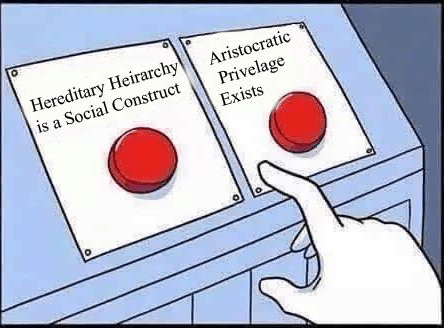
Indeed, one of the issues with feudal systems was that the entrenched aristocracies often made it difficult to replace incompetent leaders, as power and land were concentrated within their ranks. However, in modern Western societies, the ideal is to establish a meritocracy where status and positions are based on individual merit rather than inherited privileges.
A key aspect of a meritocratic system is the independence of land, property, banking, and the treasury from the government. This separation is essential because in feudal systems, the lands and resources belonged to the monarch, and the titles and positions were granted in exchange for loyalty and service. By separating these entities from the government, a meritocracy aims to ensure that individuals can rise or fall based on their own abilities and achievements, rather than relying solely on inherited wealth or connections.
In a true meritocracy, opportunities should be available to all individuals regardless of their social background, allowing them to compete on a level playing field and be rewarded based on their own talents, skills, and hard work. However, government provided subsidies degrades a merit based system, since merit of subsidies are being decided based on current opinions of the elected officials and the elected officials goals of what they get in exchange for getting an industry subsidized.
Indeed, in feudal systems sure many were corrupt but the king would delegate authority and land ownership to different ranks of nobility, creating a hierarchical structure within the society. Each rank, from duke to marquess, earl, viscount, and baron, had their own lands and responsibilities. They were motivated to cultivate their lands and generate revenue not only for themselves but also for the higher-ranking nobles to whom they owed allegiance. This system of land ownership and loyalty created a chain of command and ensured a flow of resources and taxes up to the king.
While there might have been some meritocracy within the peerage, where individuals could rise in rank based on their achievements and service, ultimately, all nobles were indebted to the king. Loyalty to the monarch was paramount, and they were expected to prioritize the king’s interests above their own. Criticizing or speaking ill of the king was generally considered taboo, and their actions and efforts were aimed at furthering the king’s agenda and maintaining the stability of the realm. So, in this feudal system, although there might have been some elements of meritocracy within the ranks of the nobility, the ultimate power and ownership rested with the king, and their actions and duties were ultimately in service to the monarchy.
The “Great Society” in the USA indeed led to a significant expansion of the government’s role in various aspects of society. It resulted in increased reliance on government subsidies, funding, and assistance across different industries and among certain groups of people. This shift represented a departure from the earlier notion that individuals primarily needed protection from external threats and basic law enforcement.
With the implementation of various programs and policies, the government became more involved in providing financial support, welfare services, and regulatory oversight in different sectors. This brought back the feudalism and clientelism, of old that all great societies had in order to achieve their bigger goals of being the PAX. Especially, when now almost every industry has become highly dependent on government subsidies and funding, while certain segments of society find themselves trapped in a cycle of reliance on government assistance, struggling to break free from the ” government handout gap.”
WHAT IS THE GOVERNMENT HAND OUT GAP?
The government trap of the handout gap arises from the vast disparity between the eligibility criteria for government assistance and the level of self-sufficiency required to break free from it. This creates a strong incentive to remain reliant on government support, as escaping the coverage gap between subsidized and market-based options demands two to three times the effort. Take the example of an egg farmer: while an independent farmer must produce 20,000 tons of eggs, a farmer receiving government subsidies is limited to 7,000 tons due to government-mandated price controls. However, for a farmer seeking to reenter the regular market, the process can be prolonged and prohibitively expensive. They would need to acquire additional chickens, equipment, and resources necessary for egg farming, effectively leaving many farmers trapped by the subsidy. Similar dynamics can be observed in government-subsidized housing and welfare programs, where the significant disparity between benefits received and the threshold for self-sufficiency discourages mobility.
Through these programs, many individuals have become dependent on the locality they were born into, akin to serfs tied to the land. While ants and sheep follow certain paths out of competency and security, in this context, people have started relying on handouts simply because they are available. This has effectively resurrected a modern version of the peasant or plebeian classes, with government assistance serving as their primary source of support.
One of the advantages political parties gain is that both sides now have automatic constituents who are obliged to vote in a certain way in order to maintain their subsidies. Policies like the Economic Opportunity Act of 1964 lay the groundwork for corrupt aristocracies to exploit the power of the state, consolidating their positions based on patronage rather than merit or the value they bring to their communities. When the government realizes it can effectively buy its constituents, the aristocracy becomes a contest to see who can appear the fairest to their clientele.
As we delve deeper into this topic, it becomes evident that natural hierarchies emerge in human societies. However, in proper systems, these hierarchies consist of two components: one that can be inherited and another that is based on merit and deservingness. In a balanced structure, even those born into high status can lose it all through imprudence and degeneration, while those with little or no initial advantages can ascend to great wealth or raise their descendants to a “wealthy” status. Therefore, status should be earned through individual effort and merit, but the value of legacy should not be disregarded solely based on its lack of popularity.
However, the Great Society implemented a system of categorizing individuals into groups eligible for government assistance. However, relying on government assistance can be likened to an addiction. It starts off as a free and seemingly helpful resource, but eventually, it becomes a dependency that can dictate your actions and livelihood. If you don’t comply with the requirements or regulations tied to the assistance, you risk losing your business, livelihood, and all the hard work you’ve invested over the years. Without this constant subsidy, the model you’ve built for yourself becomes unsustainable, leaving you reliant on the government as a sort of “big brother” figure.
Each title can be seen as a chink in the armor of communities. The communities were already weakened by letting secularism in and the division of the extended families into nuclear ones which meant that the infusion of these systems seemed okay, and not as bad as they are.Top of Form
Take the Jobs Corps as an example. When a group of people or a community becomes reliant on the government to provide them with job opportunities or job training, it indicates a failure in the traditional roles of parents and the community. It is the responsibility of parents and the community to impart skills that can lead to employment. Even if these skills are as basic as digging a 6 by 6 hole or chopping down a tree, they still serve as a foundation. With a developed skill, individuals can leverage it to acquire additional skills. Mastering one skill equips individuals with the tools and mindset needed to learn and excel in other areas.
The establishment of the Jobs Corps had the potential to be beneficial if it focused on promoting community service and encouraging participation in meaningful activities that contribute to the country or local communities. However, it fell short of its potential. The need for such a program arose because communities had not effectively organized themselves to provide job education and skills training. This allowed the government to step in and assume a role that was traditionally the responsibility of parents, community members, and religious leaders in shaping the youth.
The other programs of the Great Society aimed to provide assistance to the undereducated, impoverished individuals, as well as subsidies and loans to farmers and agricultural workers. Banks, manufactuers, miners and just about any field became able to kiss the government ring for lumps of money or special privileges. Additionally, Medicare was introduced to cater to the healthcare needs of older individuals, solidifying their support as a voter base. While these programs were designed to offer help to those in need, they also created a system of dependency. Individuals who accepted these programs often found themselves trapped in a cycle of reliance, akin to peasants in a feudal system.
However, it’s important to note that individuals still have the choice to reject these handouts and not trade their class mobility for a regular stipend. Though the decision may be challenging, there remains an opportunity for upward mobility. It requires a change in mindset, a shift in social circles, and the search for a supportive community that fosters self-reliance. By making these choices, individuals can navigate a path towards autonomy and independence.
On Military Powers
The Great Society drew inspiration from other historical societies and established a distinct class structure, assigning specific roles and responsibilities to individuals. In this system, there are no free benefits or handouts from the government that elevate one’s position fairly. Rather, everything provided by the state is contingent upon fulfilling the duties and expectations associated with one’s current station.
As mentioned earlier, feudal systems operated on a hierarchical chain of command, where individuals with titles reported to higher-ranking officials. Similarly, many other great societies or nations throughout history implemented similar structures, creating hierarchies within their respective states.
Every great society throughout history has been characterized by its military prowess. A successful military organization not only comprises various divisions with distinct roles, but even within those divisions, there are further subgroups with specific functions. This atomized structure ensures that each individual knows their role and understands the responsibilities of the person standing next to them. Through practice and training, these individuals develop a bond and the ability to move as a unified and cohesive unit. This level of unity is achieved through a deep understanding of their individual tasks and how they contribute to the overall mission.
The remarkable aspect lies in the transformation of civilians into effective members of a squad, forming part of a platoon, which is a crucial component of a larger company working in coordination with other battalions. This process requires exceptional skill and strategic thinking. Generals and colonels play a pivotal role in delegating responsibilities downstream, but at every level of command, the leader is not only reliant on their own expertise but also responsible for ensuring the competence of the individual immediately below them, who leads those under their command. This chain of accountability extends throughout the hierarchy, with each leader diligently assessing the capabilities of their subordinates and expecting the same level of assessment to be carried out by every level of command.
The intricacy of such systems lies in the effective transmission of knowledge, the elimination of ineffective practices, and a steadfast commitment to the established plan. Additionally, it is a remarkable achievement to bring together individuals from diverse backgrounds, potentially hailing from different states and following different faiths, and unite them towards a common objective. This phenomenon finds resonance in various team sports, making them valuable tools for fostering teamwork and instilling a sense of responsibility in both youth and adults alike.
The essence of nation or society building lies in instilling a belief in something greater than oneself, where each person’s work contributes to the growth and greatness of the nation. While the military aspect may be more straightforward, as individuals are taught their roles and expected to follow orders, the challenge in both military and civilian contexts is convincing people to dedicate themselves to a cause worth sacrificing for. It requires effectively selling the dream to individuals and the various factions they belong to, demonstrating how their participation will lead to a better life for themselves and future generations. This involves appealing to their sense of honor, pride, and the opportunity to be part of the best nation that has ever existed.
This sentiment can be observed in the Cold War era, where Americans held a deep fear and apprehension towards the USSR and communism. It was a time when the prevailing belief was that the values and way of life cherished by Americans were under threat. This fear played a significant role in shaping the collective consciousness of the nation throughout the 20th century.
To establish a cohesive nation or society consisting of diverse individuals with varying backgrounds, beliefs, and lifestyles, there needs to be a system that accommodates different types of people. In these divisions, individuals are recognized and appreciated for the unique contributions they make to society as a whole. This is why terms like working class, middle class, blue collar, white collar, and others were coined. Additionally, it is essential to foster a shared understanding that hierarchies exist in the world. However, these hierarchies are not about one group being inherently superior or inferior, but rather about different individuals excelling in specific roles or areas of expertise.
The unique aspect of the American concept of hierarchies, in contrast to many other “great societies,” is that it does not rely on strict hereditary aristocracy based on one’s bloodline. Instead, merit, ability, and competence play a significant role in determining one’s position within the hierarchy, depending on the field, skill, or realm they are engaged in.
A valid criticism of traditional hierarchies is that they often lacked mobility, preventing the removal of elderly or unfit individuals from positions they were no longer suited for.
The founding fathers of this country deliberately avoided the concept of a “great society” for two primary reasons. Firstly, they intended for the individual states to have the freedom to govern their respective regions as they saw fit, without imposing a unified societal framework or moral compass, apart from the fundamental principles outlined in the Bill of Rights. Unlike in other powerful nations, local state leaders were granted significant autonomy and were primarily accountable to their leaders in the capital, rather than the people they governed.
The second reason, which forms the core argument of this piece, is that the founding fathers recognized that all “great societies” inevitably require the sacrifice of individual freedoms in order to achieve their ambitious goals and aspirations. They understood that the pursuit of a collective vision often entails limitations on personal liberty and the consolidation of power in the hands of the governing authority.Bottom of Form
NOTHING IS FREE.
From the very basic necessities of life, such as the air we breathe and the water we drink, to the more complex aspects of our existence, everything carries a trade-off. Even something as fundamental as breathing involves inhaling oxygen and exhaling carbon dioxide, which affects the balance of gases in the atmosphere. Similarly, the availability of clean drinking water often requires extensive processes like desalination, which have their own environmental implications. These examples demonstrate that even the most essential elements of our lives come with complexities and trade-offs that need to be considered.
WHAT MAKES PEOPLE THINK THE GOVERNMENT IS NOT GETTING THEIR CUT!?!
The leaky buckets theory offers a useful framework for understanding this concept, that many people don’t realize is the cost of all bureaucratic machines, particularly so with federal governments. Consider a scenario where the government collects some X amount of dollars in taxes. A significant portion of this revenue is allocated towards the operation of various agencies such as the IRS and other administrative bodies, which incur significant costs. Additionally, if there are programs in place to distribute funds, there are costs associated with overseeing and managing those programs, as well as compensating the individuals working at the ground level. It is also important to consider the potential externalities that may arise from the utilization of these funds. In this way, the leaky buckets theory highlights how resources allocated by the government can encounter various costs, both visible and hidden, as they flow through different channels and sectors of society. [1]
This brings us back to the analogy of ants and sheep. Ants understand the concept that nothing comes for free. They work diligently and know that they must earn everything they receive. Even if they didn’t personally forage for food, they contribute to the hive in other ways. On the other hand, sheep have an expectation of being taken care of simply because they belong to a group. They fail to realize that the shepherd’s actions are not solely driven by benevolence. While shearing their wool may benefit their health, the shepherd ultimately benefits by using the wool to create clothing. Sheep are nurtured and protected by the shepherd to maintain their value, as without this protection, they would be vulnerable to harm or even death. It’s important to note that this protection provided by the shepherd comes at a cost to the sheep.
The government, if given the opportunity, will try to shape people into sheep. Social conditioning affects everyone, even those with a strong sense of individualism. Even the most diligent and hardworking individuals can be tempted to accept things they know they shouldn’t have if those things are readily available. They may even convince their fellow ants to do the same, just like the ant that carries back refined sugar to the hive, despite knowing its potential drawbacks.
Industries.
The industrial military complex thrives on subsidies and profits derived from war. They are awarded medals and badges of honor based on securing lucrative contracts. The media, on the other hand, serves as the government’s public relations division. When it becomes challenging to justify the corrupt actions of the government, they divert attention by pitting different groups against each other or highlighting unrelated issues in distant locations. For instance, when the Occupy Wall Street movement gained momentum, there was a sudden and significant increase in news coverage on racial issues, which has continued to escalate ever since.
Many great societies throughout history were held together either by powerful leaders or by oppressive hierarchies where disobedience to the leader meant certain death. This historical context is important to consider when we hear the FBI and DHS labeling various groups they disapprove of as domestic terrorists.
It is worth noting that most great societies faced significant challenges when their leaders passed away, when their leaders’ successors proved to be unfit or corrupt, or when regional leaders prioritized their own interests over the well-being of the society as a whole. These factors often led to the fragmentation or decline of the society.
However, corruption has always been a concern within large governmental bodies, regardless of their form. In the absence of hereditary power, which once served as a standard for upholding a family name or risking its descent into oblivion under greedy lords, politicians now have different motivations to solidify their positions. Whether it be through amassing wealth, gaining status, seeking fame, or enacting laws that favor their interests, politicians recognize that they likely only have one opportunity to leave their mark. Consequently, they may resort to employing ruthless tactics to secure their positions and advance their agendas.
The American political landscape appears to suffer from a lack of accountability stemming from the relatively short terms of elected officials. When leaders know that their time in power is limited, there is a temptation to make the most of it without considering the long-term consequences. However, accurately gauging the impact of policies over time is a challenging task.
Each successive leader must contend with the policy mistakes and challenges left behind by their predecessors, making it difficult to fully assess the intentions behind past decisions. Even granting the benefit of the doubt to leaders like LBJ, it becomes apparent that their ambitious visions may have been driven, at least in part, by a sense of hubris.
A religious education can be seen as a modern form of aristocracy. Throughout history, societies were often governed by nations, empires, or religious institutions that imposed their principles and beliefs on their people. These entities sought to expand their influence by conquering new territories and either enforcing strict adherence to their beliefs or collecting taxes for their sustenance. The success of these “great ideas” or empires was tied to their ability to push boundaries and engage in battles with those who opposed them. Additionally, they relied on hierarchical structures where individuals understood their rank, roles, class, and position in the social order.
Thus, the concept of a great society necessitates individuals being aware of their social class or role, such as nobles, plebeians, workers, or senators. In many cases, these positions are relatively fixed, although there is still some degree of social mobility, particularly driven by economic incentives. However, when the government excessively protects industries like banks, car companies, technology firms, and pharmaceutical companies, these industries become intertwined with the government itself. Consequently, the titles and programs established within the framework of the great society, as devised by LBJ, serve as tools to perpetuate the existing power structures found in nation-states and empires that have existed globally for thousands of years.
The intention behind these programs was not necessarily to uplift people out of poverty, but rather to maintain certain individuals or groups in their respective places. They give the illusion of change while subverting certain groups through an educational system that LBJ would not have subjected his own relatives to, as it propagates a secular indoctrination.
The New Age of Aristocracies
If we examine elected officials, it is noticeable that the majority, if not all, have had a significant religious upbringing. Whether they attended private schools, Sunday schools, or were exposed to religion in various ways, it has shaped their early experiences. While many may not actively practice their religion now, it is still consequential as they have adopted a secular approach while being influenced by the religious principles they were raised with. This influence is evident in how information is conveyed in the world, particularly in the United States. Religious precepts, such as the notion of the end of days, the distinction between good and bad actors, the identification of enemies, and adherence to moral imperatives, continue to shape the way information is presented and perceived.
In the realm of American politics, one way to analyze the ongoing battles is by examining the concept of aristocracy. The right-wing tends to prioritize religious affiliation or competence in specific issues as qualities that should define elected officials. They argue that these attributes align with their vision of leadership. On the other hand, the left-wing focuses on identity markers such as race, gender, and sexual orientation, aiming to include historically marginalized groups within the ranks of power. This perspective stems from a discourse of oppressor versus oppressed, where the left seeks to empower the previously oppressed as a form of equity and fairness, challenging the traditional aristocracy.
However, it is important to recognize that government programs can inadvertently strengthen the aristocracy of religious groups. This is because religious individuals tend to have larger families and prioritize passing on their faith to their children. Conversely, if you belong to a group that perceives themselves as oppressed, the education or belief system becomes solely focused on being anti-establishment. As a result, there is often a lack of substantive values or practices being transmitted to the next generation. While the left’s fight for social justice may gain momentum over time, their communities can face internal divisions as each new generation sees the previous generation as not being extreme enough. This can lead to the creation of terms such as TERF (trans-exclusionary radical feminist) or MAPs (minor-attracted persons) as each generation seeks to push the boundaries further and labels former allies as enemies.
This is why religious traditions often exhibit characteristics similar to autocracies in this country. While financial wealth tends to dissipate over time, religious legacies have proven to be more enduring. The 3rd generation curse affects most secular or lazy families, causing their financial legacies to crumble. While various theories attempt to explain the persistence of religious groups, a more secular understanding is that religious values withstand the test of time by providing strict traditions and rules for established families and their lives. These religions have codified and canonized teachings on how to navigate the external world and resolve internal conflicts of the soul, spirit, and flesh. Virtually all notable religions encourage their followers not to trust their base desires and to prioritize long-term goals over immediate pleasures.
However, even these achievable aristocracies, open to individuals from any walk of life, rely on communities that prioritize a specific set of values above all else. Without such a foundation, we risk seeing degenerate individuals in positions of power, who are essentially secular versions of the faiths they were raised in. These individuals may possess the ability to set aside distractions, but they still prioritize personal pleasure over true values. Even those who do not actively follow the rules or traditions they were raised with still possess a toolbox of principles that non-theists are attempting to construct for themselves through various ideologies based on “why not” isms.
In conclusion, it is essential to recognize ourselves as autonomous individuals who uphold the traditions of our ancestral culture. We should embrace the values that provide meaning to our genealogy, encompassing our past, present, and future. By actively working hard every day, we contribute to the strength and growth of the community that gives our lives purpose and significance. Rather than being defined solely as an ant or a sheep, a serf or a lord, or a soldier or a citizen, our true identity lies in being individuals who cherish and actively nurture the traditions and values that shape our sense of belonging and that provides meaning to your genealogy (past, present and future) and what one works on everyday to strengthen that community that gives life purpose.
I embrace both the positive and negative aspects that have been mentioned, as they exist in different areas of my life. However, my commitment lies in striving every day to move closer to the ideal and to rise stronger each time I encounter setbacks. Even if it may seem unconventional, I believe it is worthwhile to express my beliefs passionately if it helps just one person to gain a new perspective and find their own enlightenment.
[1] https://www.reed.edu/economics/parker/201/cases/leaky.html (1) Reductions in work effort both by the rich who have lower after-tax wages due to the tax and by the poor who now have additional non-labor income and who may be dissuaded from work if earning more disqualifies them from the transfer program. (2) Saving and investment may be discouraged by high tax rates on income both because the incentives to accumulate wealth are reduced and because the wealthy typically save more of their income than the poor. (3)Socio-economic leakages due to the possible stigmatization of wealth accumulation, which may cause individuals to try less hard to be productive and get rich.
 The Wall